

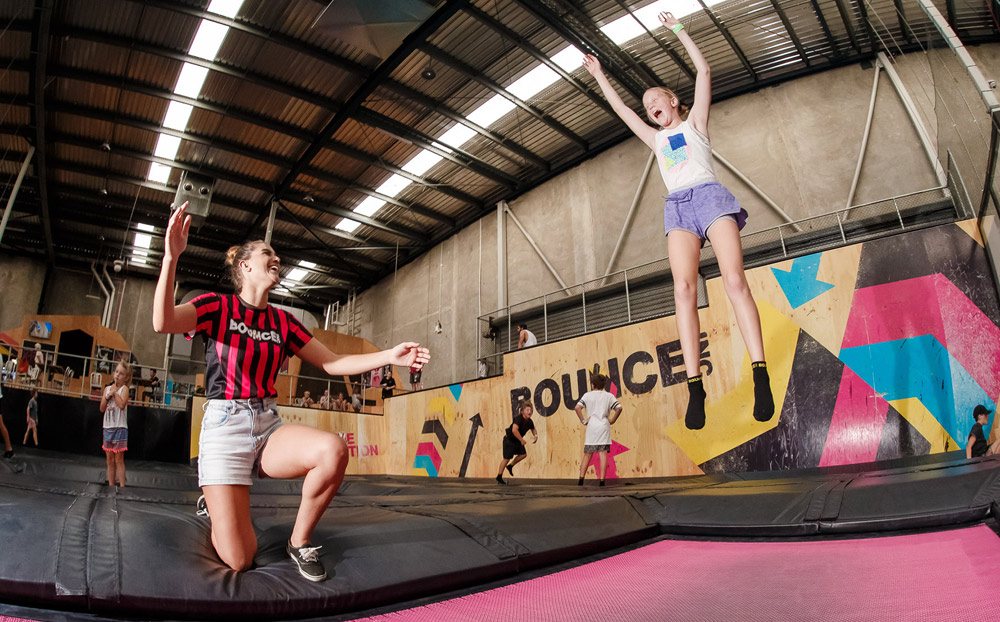
When you watch someone bounce on a trampoline, the movement looks deceptively simple. What is actually happening beneath the surface, both in the trampoline mat and within the human body, is a sophisticated interaction of forces, muscle activations, and joint dynamics that makes rebounding one of the most biomechanically interesting exercise formats available today.
Understanding what happens physically during a trampoline class singapore session helps explain why it produces such broad physiological benefits across cardiovascular fitness, muscular strength, and neuromuscular coordination simultaneously, rather than targeting just one system in isolation. The mechanics of bouncing are worth examining in detail.
The Force Dynamics of Rebounding
Every bounce involves two distinct phases that create a unique force environment for the body.
During the loading phase, when you land on the mat, the elastic surface deforms and stores kinetic energy. The ground reaction force during this phase is spread over a longer time period than landing on a hard surface, which is why trampoline exercise is classified as low-impact despite being aerobically intense. The peak force transmitted to the joints is significantly lower than running, yet the muscular demand remains high because the body must absorb and redirect the stored energy efficiently.
During the propulsion phase, the mat releases its stored energy and propels you upward. Your muscles must work concentrically to amplify this launch, coordinating the timing of ankle plantar flexion, knee extension, and hip extension in a rapid sequence. This chain of muscle activation, known as a triple extension pattern, is the same foundational movement used in jumping, sprinting, and Olympic lifting.
Muscle Groups Engaged During a Trampoline Session
One of the reasons trampoline class training produces comprehensive conditioning results is the breadth of muscle groups involved in every bounce:
- Gastrocnemius and soleus: Primary drivers of ankle plantar flexion during takeoff and shock absorbers during landing
- Quadriceps: Control knee flexion on landing and drive knee extension on takeoff
- Hamstrings and gluteus maximus: Stabilise the hip and contribute to propulsion force
- Core musculature: The deep stabilisers, including the transverse abdominis and multifidus, work continuously to maintain spinal alignment throughout each bounce cycle
- Upper body stabilisers: Shoulder and upper back muscles engage during arm movement, which contributes to momentum and balance control
The continuous, rhythmic nature of a trampoline session means these muscle groups work together in rapid succession across many repetitions, producing both strength and endurance adaptations over consistent training periods.
The Role of the Stretch-Shortening Cycle
Trampoline training is a powerful stimulus for the stretch-shortening cycle (SSC), which is the mechanism underlying explosive athletic movement. The SSC occurs when a muscle is rapidly lengthened in the eccentric phase immediately before it contracts concentrically. This pre-stretch stores elastic energy in the muscle-tendon unit, which is then released during the concentric contraction, amplifying force output beyond what a purely concentric contraction could produce.
Every landing-to-takeoff transition on a trampoline is an SSC event. The calf muscles and quadriceps are eccentrically loaded on contact with the mat and concentrically contracted a fraction of a second later during takeoff. Repeating this thousands of times across a session trains the neuromuscular system to execute SSC movements faster and more powerfully, a quality that transfers directly to athletic performance on the ground.
Joint Loading Compared to Ground-Based Exercise
The elastic surface of a trampoline distributes impact forces across time and surface area, resulting in substantially lower joint loading than equivalent-intensity ground-based exercise. Studies comparing rebounding to treadmill running at similar cardiovascular intensities have found that joint reaction forces at the knee and ankle are meaningfully reduced during rebounding.
This makes trampoline training particularly valuable for:
- Individuals managing early-stage joint conditions who need to stay active without aggravating joint surfaces
- Heavier individuals for whom high-impact ground exercise carries elevated injury risk
- Older adults who want cardiovascular conditioning without cumulative joint wear
- Athletes managing lower limb overuse injuries who need to maintain fitness during modified training phases
The reduced joint stress does not come at the cost of muscular demand. Because the mat surface is unstable and responsive, the muscles must work harder to control movement throughout each bounce, maintaining a high training stimulus even as joint loading remains low.
Postural Demands and Core Stability
Maintaining a stable, upright posture on a moving surface is neurologically demanding. The core musculature must make continuous micro-adjustments throughout every trampoline session to prevent postural collapse and maintain efficient bounce mechanics. This is a fundamentally different core challenge than performing isolated core exercises on a stable surface.
Over time, this continuous postural demand leads to meaningful improvements in functional core stability, which is the ability of the deep trunk muscles to protect the spine and transfer force effectively during dynamic movement. Improved functional core stability has downstream benefits for posture, lower back health, and athletic performance across many activities.
TFX Singapore designs its rebound class programming to progressively increase the complexity and intensity of movement patterns, ensuring that participants continue to develop neuromuscular adaptations as their fitness levels improve over time.
Training Efficiency of the Trampoline Format
From a training economy perspective, trampoline class sessions are highly efficient. The combination of cardiovascular demand, multi-joint muscular engagement, SSC training, and neuromuscular coordination challenge means that a single session delivers training stimuli that would otherwise require separate strength, cardio, and balance training sessions to replicate. For Singapore residents managing demanding work schedules, this efficiency is a meaningful practical advantage alongside the physiological benefits.
FAQ
Q: Does jumping technique affect the biomechanical benefits of a trampoline session? Yes, significantly. Landing with soft knees, maintaining an upright torso, and using arms actively for balance and momentum all improve both safety and training effectiveness. Most structured classes include technique coaching as part of the session delivery.
Q: Can trampoline training improve performance in running sports? The stretch-shortening cycle training and triple extension mechanics developed during trampoline sessions transfer well to running, jumping, and lateral movement sports. Many athletes use rebounding as cross-training specifically to develop explosive leg power.
Q: Is there a recommended session frequency for maximising biomechanical adaptations? Two to three sessions per week with at least one rest day between sessions allows the neuromuscular system to consolidate adaptations. Exceeding this without adequate recovery can lead to diminishing returns.
Q: How does body weight affect the forces experienced during a trampoline session? Heavier participants experience proportionally greater gravitational loading during the landing phase, which increases both the joint stress and the muscular effort required to absorb and redirect that force. This is why proper landing mechanics are particularly important for heavier individuals starting trampoline training.