

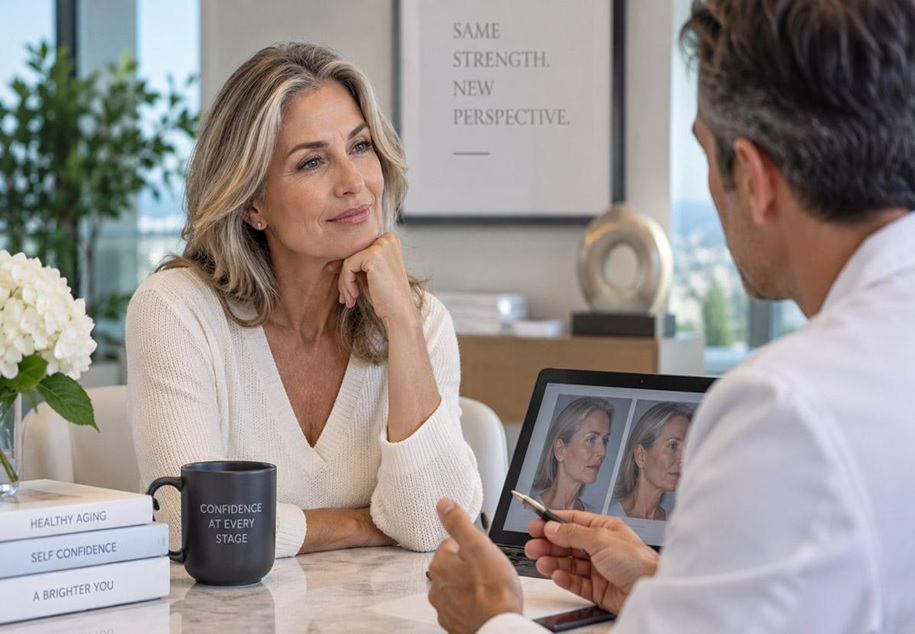
Research suggests that people who pursue aesthetic surgery for their own reasons, with specific and modest expectations, report the highest satisfaction. Data indicates older patients are often more satisfied than younger ones for exactly that reason. Safety in this decade depends on health status rather than age, and a good consultation examines motivation, medical history, and timing with equal care.
Deciding about surgery in your 50s and 60s is rarely a decision about a single feature. It is usually a decision about the relationship between how you feel and what you see and whether closing that gap is worth an operation. That is a psychological question as much as a surgical one, and board-certified plastic surgeon Dr. Siamak Agha treats it that way at The One Plastic Surgery Center in Newport Beach.
There is a persistent assumption that wanting aesthetic surgery later in life means refusing to age. The clinical literature offers a different perspective. Motivation, expectation, and health status predict outcomes far more reliably than the number on a birth certificate.
This piece looks at what the research says about why people choose this in midlife, how satisfied they tend to be, what actually governs safety at this age, and what a careful consultation should examine before anyone schedules anything.
Why This Decade Brings the Question Forward
For many people, the fifties and sixties are the first time the face in the mirror stops matching their internal sense of self. Skin loses elasticity, facial fat shifts downward, and the changes that accumulated slowly become visible all at once in a photograph.
Research on cosmetic surgery interest describes both social and personal drivers. A review in Frontiers in Psychology notes that messages from partners, family, friends, and social media all shape the impulse, alongside internal factors such as body dissatisfaction and anxiety about aging.
That distinction matters because the two categories behave differently over time. Feelings driven by a comment someone made or a photograph on a screen tend to move. A long-held private wish tends to stay put.
Neither one disqualifies anyone. Recognizing which is driving you simply changes the conversation you should have, and it is a conversation worth having before the surgical one.
What Motivates Surgery in Your 50s and 60s
Clinicians generally distinguish internal motivation from external motivation. Internal motivation means the patient is bothered by something specific and wants it addressed for their reasons. External motivation means the pressure originates elsewhere: a partner, a workplace, or a comparison.
The same Frontiers review links stronger interest in cosmetic procedures to traits such as appearance-based rejection sensitivity and socially prescribed perfectionism, both of which describe appearance concern shaped largely by how others might react. It recommends psychological assessment when a decision appears driven mainly by anxiety about being judged.
This is not a reason to feel scrutinized at a consultation. It is the basis for a practical question a thoughtful surgeon will ask in some form: if nobody else ever commented on the procedure again, would you still want it changed?
Patients who can answer yes tend to describe their goals in concrete, modest terms. They want the jawline to look less heavy or the upper eyelids to stop feeling tired. They are not asking for surgery to resolve something surgery does not touch.
What the Satisfaction Research Actually Shows
Aesthetic outcomes in this age group are measured more rigorously than most people assume. The FACE-Q is a validated patient-reported outcome instrument, meaning patients rate their appearance and well-being on scales tested for reliability.
A prospective multicenter study published in Aesthetic Plastic Surgery followed 36 facelift patients with a median age of 58.5 years across five centers. FACE-Q scores rose significantly by three months and held steady at six and twelve months, and patients perceived themselves as roughly six years younger, a perception that remained stable across the follow-up year.
More striking is what happens when researchers compare age groups directly. A retrospective cohort of 248 facial rejuvenation patients in Aesthetic Plastic Surgery found that younger patients arrived with significantly higher expectations and reported lower satisfaction afterward while older patients came in with more modest expectations and reported better satisfaction relative to them.
Age and preoperative expectations were independent predictors of dissatisfaction in that analysis. The pattern is not that older patients get better surgical results. It is that expectation calibrated to reality that is one of the strongest levers anyone has, and it tends to improve with life experience.
Health, Not Age, Governs Surgery in Your 50s and 60s
The safety question deserves a direct answer. Published data indicates that chronological age by itself is a poor predictor of complications in elective aesthetic surgery and that measurable health status is a much better one.
A review of the CosmetAssure database covering 183,914 cosmetic procedures, published in the Aesthetic Surgery Journal, included 6,786 patients aged 65 and over with a mean age of 69.1 years. Overall complication rates were not significantly different from younger patients, and even among patients 80 and over, the rate was 2.2 percent. Abdominoplasty was the exception, showing higher complication rates in older patients.
The American Academy of Dermatology reaches a similar conclusion, citing a study of 129,007 patients in which serious complication risk was comparable between older and younger groups and noting that the older patients studied were generally in better health, with lower smoking rates.
More recent work supports this conclusion. An analysis in Aesthetic Surgery Journal Open Forum of 111,173 elective aesthetic patients found that among those 65 and over, a modified frailty index score above two predicted complications better than age did, identifying a group that accounted for roughly a quarter of all complications.
This is why a consultation at this stage of life involves a genuine medical review: cardiac and pulmonary history, diabetes control, blood pressure, sleep apnea, bone health, smoking, alcohol, and a full medication and supplement list, since blood thinners and some supplements affect bleeding risk. Many practices also apply enhanced recovery protocols, a standardized approach that a systematic review associates with shorter stays, lower opioid use, and better reported patient experience.
When Expectations Deserve a Closer Look
Screening is part of responsible practice, and it protects patients rather than excluding them. Body dysmorphic disorder is a mental health condition in which a person becomes preoccupied with a perceived flaw that others barely notice, and surgery characteristically fails to relieve it.
The American Society of Plastic Surgeons reports that the condition affects roughly 2 to 10 percent of patients seeking cosmetic procedures and is likely underdiagnosed. In the survey it describes, only 7 percent of cosmetic professionals routinely raised body image during consultations, and researchers argued that body image should become a standard consultation topic.
Most people in their fifties and sixties who want a facelift or eyelid surgery are nowhere near this territory. They have a specific, visible concern and a reasonable idea of what changing it would and would not do.
Still, some expectations are worth discussing openly. Surgery does not repair a marriage, reverse a job loss, or return a face to a photograph from thirty years ago. A surgeon who says so plainly is providing you better information than one who agrees with everything.
“Age is a weak predictor of surgical risk. Measured health status and honest expectations are far stronger ones.”
Timing, Life Transitions, and What a Good Consultation Covers
Timing often clusters around transitions. Retirement, a last child leaving, the end of a long caregiving period, a divorce, or a return to dating all free up attention that was spent elsewhere for years, and the postponed question comes back.
Transitions can also destabilize judgment. The common clinical guidance is to avoid making a permanent decision during the most acute phase of an upheaval and to give yourself a season of distance instead. If the wish is durable, it will still be there.
A thorough consultation addresses more areas than most people expect:
- What specifically bothers you, in your own words, and how long it has
- Whether the motivation is yours or largely someone else’s
- Full medical history, medications, supplements, and prior surgeries
- Anesthesia plan, facility accreditation, and who will monitor you
- Realistic recovery time and the help you will need at home
- What the procedure will not change, stated plainly
That last item is the one worth listening for. Whether the conversation concerns a deep plane facelift, a less extensive technique, or no surgery at all, the value of a consultation lies in an honest map of the options, including the option of waiting.
Key Takeaways
- Motivation matters more than age, and internally driven, specific goals are associated with higher satisfaction.
- Published FACE-Q data indicates older facial surgery patients often report better satisfaction than younger ones, largely because their expectations are more modest.
- Health status and frailty predict complications far better than chronological age, which makes a thorough medical and medication review essential.
- Screening for body dysmorphic disorder and unrealistic expectations protects patients rather than excluding them.
- Life transitions often prompt the question, but a durable wish is worth more than an urgent one.
Results and candidacy vary from patient to patient. Nothing here predicts any individual outcome, and only an in-person consultation with a board-certified plastic surgeon can determine whether a procedure is appropriate for you.
A Decision Worth Taking Slowly
The psychology of choosing surgery in your 50s and 60s comes down to a few honest questions. Is this yours? Is it specific? Is your health in a place that supports it? Is the timing steady rather than reactive?
People who can answer those clearly tend to do well, and the data on satisfaction in this age group is encouraging for exactly that reason. People who cannot answer them yet are not being turned away. They are being given the most useful thing a surgeon can offer, which is time and accurate information.
If you would like to explore whether a procedure fits your goals and your health at this stage of life, schedule a consultation with board-certified plastic surgeon Dr. Siamak Agha at The One Plastic Surgery Center in Newport Beach to discuss your goals and options.
Frequently Asked Questions
Am I too old for cosmetic surgery in my 60s?
Published data indicates chronological age alone is a poor predictor of complications. A review of 183,914 cosmetic procedures found overall complication rates in patients 65 and older were not significantly different from younger patients. Health status, frailty, and medication profile matter far more, and we assess all of that in person.
Do older patients regret aesthetic surgery more often?
Research suggests the opposite pattern. A cohort study of facial rejuvenation patients found younger patients had higher preoperative expectations and lower postoperative satisfaction, while older patients entered with more modest expectations and reported better satisfaction. Expectation calibration appears to be the driving factor.
How do I know if I want this procedure for the right reasons?
A useful test is whether the concern would still bother you if nobody else ever mentioned it. Motivation that originates with you, attached to a specific and visible change, is associated with better satisfaction than motivation driven mainly by pressure from a partner, workplace, or social comparison.
What health issues could delay or prevent surgery?
Uncontrolled blood pressure or diabetes, significant cardiac or pulmonary disease, untreated sleep apnea, active smoking, and certain medications or supplements that affect bleeding can all change the plan. Some are temporary obstacles that optimization resolves; others make elective surgery inadvisable. Only a full evaluation can sort them out.
Should I wait if I have just retired or gone through a major life change?
Often, yes. Most surgeons suggest putting some distance between an acute upheaval and a permanent decision, because judgment during a transition can be unreliable. A wish that remains steady several months later is a much better basis for planning than one that arrives in the middle of a crisis.